


Latest news
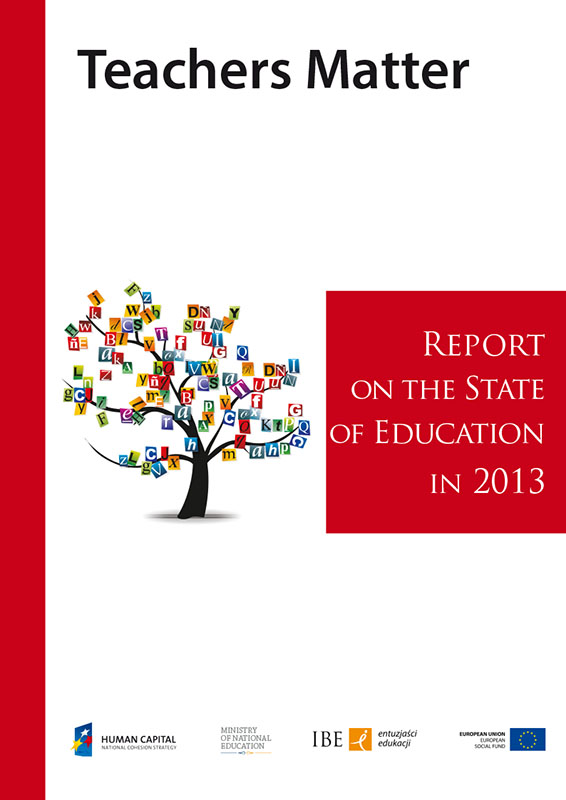
- Report on the State of Education in 2013
- Simulation and Prognostic Structural Model of the Polish Economy Including Human Capital Formation
- Digital Reality of Polish lower secondary school students (ICILS 2013)
- Polish Lower Secondary School Teachers and Headmasters in the Light of Teaching and Learning International Survey (TALIS 2013)
- 8,000 schools have signed up for National Study of the Third Graders' Skills
- Teaching Tools Database in KeyCoNet Catalogue of Initiatives 2014
About the Project
The main goal of the project is strengthening the education system in the field of educational research and the improvement of the use of research findings in education policy, practice and management. |
About the Institute
The Educational Research Institut (IBE) is an institution conducting interdisciplinary research concerning the functioning and effectiveness of the education system in Poland. |
The Report
This publication presents the highlights of the Report on the State of Education 2010. The Report is a synthesis of basic statistical data concerning education, the labour market, demography, social policy and the results of domestic surveys. |
The Team
The Institute employs over 130 education researchers - mainly sociologists, psychologists, educators, economists, political scientists - most of whom are eminent specialists in their fields with considerable professional expertise. |



Research
 |
The Study of Novice Teachers The aim of the study of novice teachers is to assess the practical preparation of teachers and the professional adaptation of novice teachers in school. |
 |
Laboratory of Thinking The main aim of the study is to provide information on the level of scientific knowledge of 'gimnazjum' (middle school) graduates taught according to the new curriculum. |
 |
Legal Foundations of Teaching Profession in Poland The aim of the study is to obtain a clear picture of the current legal regulations regarding the professional status of teachers and their influence on the functioning of the educational system. |
Learning and teaching foreign languages study starts in schools
- Published on Thursday, 29 March 2012 22:54
“Study of learning and teaching foreign languages in lower secondary schools" starts on 5 March, in 120 selected schools in Poland. During the conference on 27 February, headmasters and representatives of the schools participating in the study had an opportunity to learn more about its assumptions and purpose as well as find out how schools will benefit from the project.
The meeting was primarily organizational in nature: IBE experts and representatives of Millward Brown SMG/KRC, which conducts the study on behalf of the Institute, presented its schedule and organization and responded to questions. The main purpose of the study is to observe how lower secondary school students' skills in using English are changing and to find out what factors positively influence the acquisition of language skills. The study will also help to gain valuable insights into the process and organization of English language teaching and provide information on the expectations of students concerning schools and teachers, their opinions about the classes, what motivates them to learn and their attitude to the lower secondary school external examination. The study will also yield information on the conditions for home language study and exposure to the language outside of school - IBE experts hope to find out whether students have opportunities to learn the language informally.
The voice of students is often ignored, and yet they are the primary recipients of the curriculum content, which is why it is so important to us, said Magdalena Szpotowicz, Ph.D, from IBE.
The study will take three years to complete (2011-2014). It will involve six thousand students from 120 lower secondary schools as well as English language teachers and headmasters. In March, the students will take their language skills tests. Also in March, headmasters, teachers and students will complete questionnaires (headmasters and teachers will use an online version) and a survey of textbooks and curricula will take place.
Individual interviews with headmasters, teachers and students will be conducted in April and May. During the two months lesson observations in 40 selected schools will be held.
Piotr Jakubowski from Millward Brown SMG/KRC discussed the organization of the study: deadlines for individual parts of the study, the need to obtain parental consent for children's participation in the interviews and tests. He also presented tangible benefits for the schools and students.
Michał Sitek, Ph.D, Deputy Director for Research at IBE, reassured teachers that the objective of the study was not an assessment of a particular school or teacher, but – while maintaining full anonymity – a diagnosis of foreign language teaching in schools throughout the country. He also emphasized that the study would be conducted so as to minimally interfere with school.
.