

Latest news
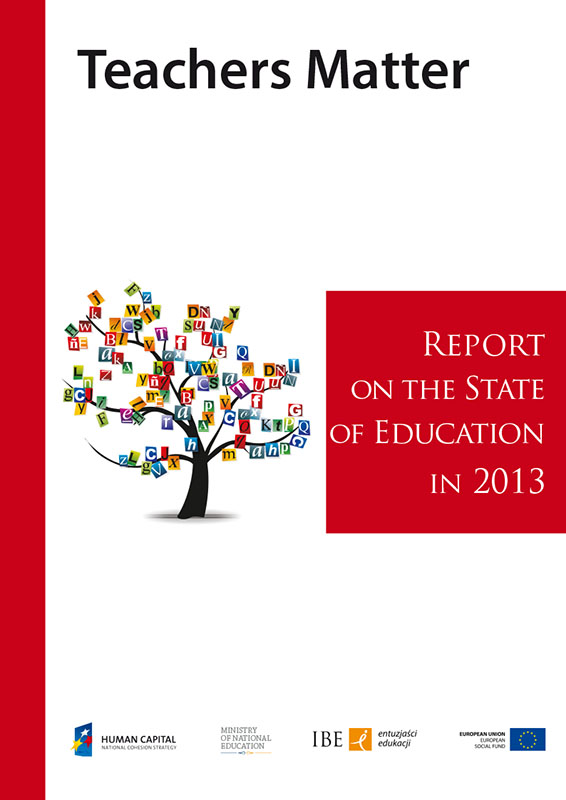
- Report on the State of Education in 2013
- Simulation and Prognostic Structural Model of the Polish Economy Including Human Capital Formation
- Digital Reality of Polish lower secondary school students (ICILS 2013)
- Polish Lower Secondary School Teachers and Headmasters in the Light of Teaching and Learning International Survey (TALIS 2013)
- 8,000 schools have signed up for National Study of the Third Graders' Skills
- Teaching Tools Database in KeyCoNet Catalogue of Initiatives 2014
About the Project
The main goal of the project is strengthening the education system in the field of educational research and the improvement of the use of research findings in education policy, practice and management. |
About the Institute
The Educational Research Institut (IBE) is an institution conducting interdisciplinary research concerning the functioning and effectiveness of the education system in Poland. |
The Report
This publication presents the highlights of the Report on the State of Education 2010. The Report is a synthesis of basic statistical data concerning education, the labour market, demography, social policy and the results of domestic surveys. |
The Team
The Institute employs over 130 education researchers - mainly sociologists, psychologists, educators, economists, political scientists - most of whom are eminent specialists in their fields with considerable professional expertise. |


Research
 |
The Study of Novice Teachers The aim of the study of novice teachers is to assess the practical preparation of teachers and the professional adaptation of novice teachers in school. |
 |
Laboratory of Thinking The main aim of the study is to provide information on the level of scientific knowledge of 'gimnazjum' (middle school) graduates taught according to the new curriculum. |
 |
Legal Foundations of Teaching Profession in Poland The aim of the study is to obtain a clear picture of the current legal regulations regarding the professional status of teachers and their influence on the functioning of the educational system. |
Study visit to Finland
- Published on Monday, 05 December 2011 08:56
Between 23 and 30 January 2011, a group of five employees of the IBE Science Section (PPP) paid a study visit to Helsinki and Jyvaskyla (about 270 km north-east of Helsinki) in Finland. The main purpose of the visit was to gain better understanding of:
- Finnish education system at ISCED level II;
- methods and forms of school work and teaching conditions for science subjects;
- teacher education and in-service training in Finland..
During the visit the IBE PPP team was accompanied by two interpreters, Ms. Katarzyna Włodecka-Ruutu and Ms. Päivi Erola, who were of great help, not only during lessons and interviews but also in organising daily work schedule.
In Jyvaskyla the team visited four schools at ISCED level II (corresponding to the Polish middle school "gimnazjum"): Nisulanmaen Koulu in Muurame, Tikkakosken Ylaaste in Tikkakoski, Kuokkalan Koulu and a Teacher Training School (Normaalikoulu), where future teachers complete their teaching traineeship. In Helsinki, the team visited two schools: a Swedish language school (Mattlidens Gymnasium) and Tehtaanpuiston Yläasteen Koulu.
The team observed a total of 24 lessons in biology, chemistry and physics, but also took part in mathematics and design technology classes and conducted a number of interviews with head teachers, science teachers and pupils. The team visited the Finnish Institute for Educational Research in Jyvaskyla, the Luma Centre in Helsinki, teacher training school in Normaalikoulu, the Heureka Science Centre near Helsinki and the Educa Education Fair in the Finnish capital. The team members also met with Pasi Reinikainen of The Finnish Education Evaluation Council in Jyvaskyla.
A summary report of the visit is due soon.
The visit was part of the research project “Analysis of the Functioning of Science Education in Selected Countries”