


Latest news
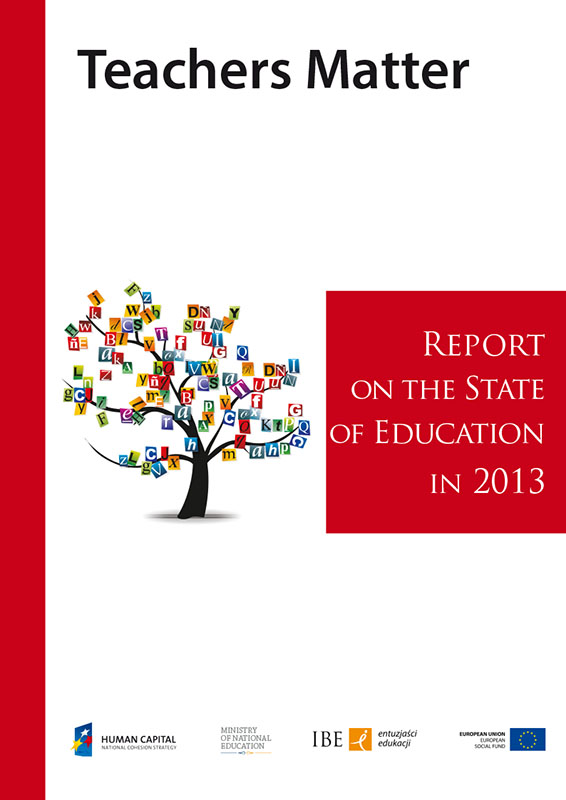
- Report on the State of Education in 2013
- Simulation and Prognostic Structural Model of the Polish Economy Including Human Capital Formation
- Digital Reality of Polish lower secondary school students (ICILS 2013)
- Polish Lower Secondary School Teachers and Headmasters in the Light of Teaching and Learning International Survey (TALIS 2013)
- 8,000 schools have signed up for National Study of the Third Graders' Skills
- Teaching Tools Database in KeyCoNet Catalogue of Initiatives 2014
About the Project
The main goal of the project is strengthening the education system in the field of educational research and the improvement of the use of research findings in education policy, practice and management. |
About the Institute
The Educational Research Institut (IBE) is an institution conducting interdisciplinary research concerning the functioning and effectiveness of the education system in Poland. |
The Report
This publication presents the highlights of the Report on the State of Education 2010. The Report is a synthesis of basic statistical data concerning education, the labour market, demography, social policy and the results of domestic surveys. |
The Team
The Institute employs over 130 education researchers - mainly sociologists, psychologists, educators, economists, political scientists - most of whom are eminent specialists in their fields with considerable professional expertise. |



Research
 |
The Study of Novice Teachers The aim of the study of novice teachers is to assess the practical preparation of teachers and the professional adaptation of novice teachers in school. |
 |
Laboratory of Thinking The main aim of the study is to provide information on the level of scientific knowledge of 'gimnazjum' (middle school) graduates taught according to the new curriculum. |
 |
Legal Foundations of Teaching Profession in Poland The aim of the study is to obtain a clear picture of the current legal regulations regarding the professional status of teachers and their influence on the functioning of the educational system. |
Seminar: Changes in Student Performance since 2000
- Published on Monday, 05 December 2011 08:55
On 10 February 2011, a seminar was held at the Chancellery of the Prime Minister in Warsaw on the results of The Programme for International Student Assessment (PISA) in 2000–2009.
.The seminar was inaugurated by the Prime Minister, Donald Tusk.The Programme for International Student Assessment (PISA) is one of the most important international studies in the area of education, coordinated by the OECD. It aims to evaluate education systems worldwide by testing the skills and knowledge of 15-year-old students in participating countries. Since 2000 over 70 countries and economies have participated in PISA.
"PISA assesses how far students near the end of compulsory education have acquired some of the knowledge and skills that are essential for full participation in society. In all cycles, the domains of reading, mathematical and scientific literacy are covered not merely in terms of mastery of the school curriculum, but in terms of important knowledge and skills needed in adult life."1
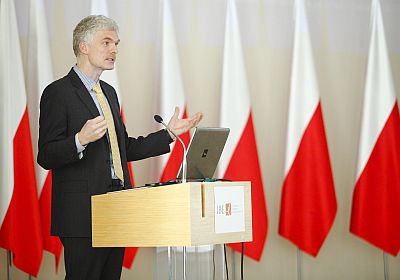
Among the participants were Katarzyna Hall, Minister of Education, Michał Boni, Chairman of the Permanent Committee of the Council of Ministers, Andreas Schleicher, Head of the Indicators and Analysis Division, Directorate for Education, OECD, and Michał Federowicz, Director of the Educational Research Institute responsible for the Polish PISA Team.
During the first session, OECD experts presented the PISA results for 2009. Their presentations are listed below:
- PISA 2009 Results – Andreas Schleicher, Head of the Indicators and Analysis Division, Directorate for Education, OECD [download]
- Learning Trends. Changes in Student Performance since 2000 – Maciej Jakubowski, Indicators and Analysis Division, Directorate for Education, OECD [download]
 Andreas Schleicher
In the afternoon session, the results of some countries which have significantly improved their student performance between 2000 and 2009 were discussed. The results of Polish students were presented by Michał Federowicz, Director of the Educational Research Institute.
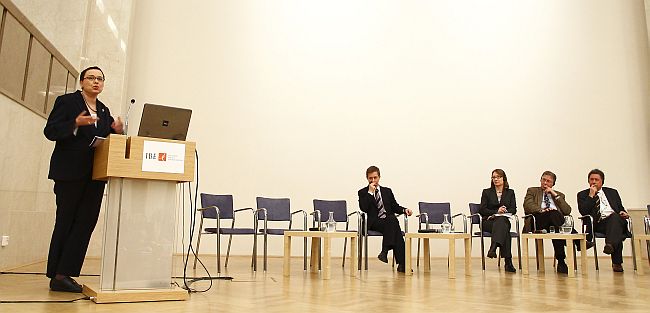
Afternoon session presentations:
- Poland – Michał Federowicz, Educational Research Institute (IBE)
- Germany – Nina Jude, German Institute for International Educational Research (DIPF) [download]
- Hungary – Gabor Halasz, ELTE University, Budapest [download]
- Portugal – Carlos Pinto Ferreira, Head of Statistics and Planning Department (GEPE), Ministry of Education and Anabela Serrão, Student Evaluation Department (GAVE), Ministry of Education [download]
The seminar was organised by the Educational Research Institute as a part of the series ‘Research in Educational Policy’.