


Latest news
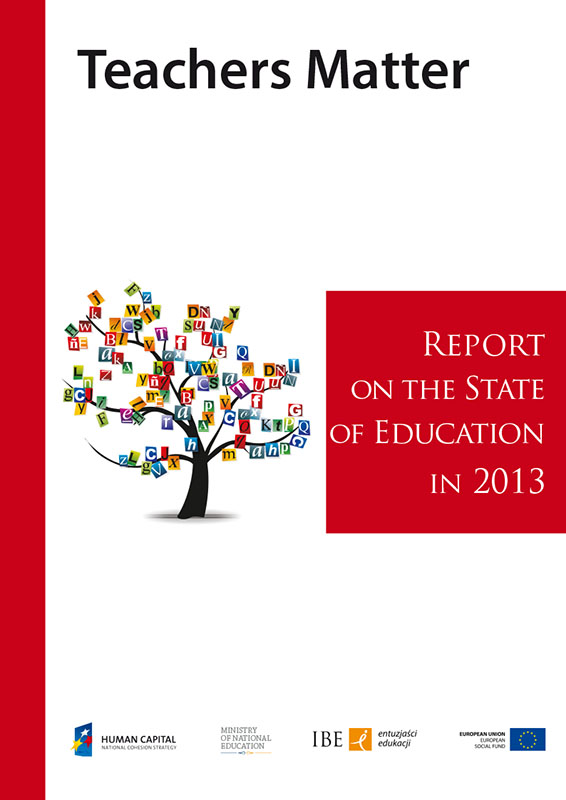
- Report on the State of Education in 2013
- Simulation and Prognostic Structural Model of the Polish Economy Including Human Capital Formation
- Digital Reality of Polish lower secondary school students (ICILS 2013)
- Polish Lower Secondary School Teachers and Headmasters in the Light of Teaching and Learning International Survey (TALIS 2013)
- 8,000 schools have signed up for National Study of the Third Graders' Skills
- Teaching Tools Database in KeyCoNet Catalogue of Initiatives 2014
About the Project
The main goal of the project is strengthening the education system in the field of educational research and the improvement of the use of research findings in education policy, practice and management. |
About the Institute
The Educational Research Institut (IBE) is an institution conducting interdisciplinary research concerning the functioning and effectiveness of the education system in Poland. |
The Report
This publication presents the highlights of the Report on the State of Education 2010. The Report is a synthesis of basic statistical data concerning education, the labour market, demography, social policy and the results of domestic surveys. |
The Team
The Institute employs over 130 education researchers - mainly sociologists, psychologists, educators, economists, political scientists - most of whom are eminent specialists in their fields with considerable professional expertise. |




Research
 |
The Study of Novice Teachers The aim of the study of novice teachers is to assess the practical preparation of teachers and the professional adaptation of novice teachers in school. |
 |
Laboratory of Thinking The main aim of the study is to provide information on the level of scientific knowledge of 'gimnazjum' (middle school) graduates taught according to the new curriculum. |
 |
Legal Foundations of Teaching Profession in Poland The aim of the study is to obtain a clear picture of the current legal regulations regarding the professional status of teachers and their influence on the functioning of the educational system. |
The Conference in Antwerp on the Relationship between Education and the Labour Market
- Published on Monday, 05 December 2011 08:49
The principal objective of the Conference in Antwerp was to outline the strategy of the EU Member States concerning the challenging relationship between education and the labour market. The Conference participants discussed the effectiveness of active labour-market policies and the issues concerning their implementation.
.The two-day discussion concentrated on analysing the role and place of active policies within the European Employment Strategy, the role of public employment services in implementing active labour-market policies, occupational counselling for people seeking employment, “active restructuring,” i.e. reforms implemented during the financial crisis in selected Member States, training courses as the means of increasing employability, and on the social economy.
The Conference was organised by the Belgian government, currently presiding over the Council of the European Union.